

Trip Through Ireland: A Practical Guide to Plan Your Route
A trip through Ireland works best when you commit to one region or one loop, allow at least 7 to 10 days, and plan around driving times rather than distances on a map. The island is small, but narrow roads, coastal detours and changeable weather mean that a route covering too much ground leaves little time to enjoy any of it.
This guide walks you through the decisions that matter: how long to stay, which route to choose, when to go, how to get around and how to build a plan you can actually follow. It is written for independent travelers who want to organize their own journey without spending dozens of hours on research.
How Long Should You Spend on a Trip Through Ireland?
Plan for 7 to 10 days if you want to see a meaningful slice of the country without rushing, and add days only if you want to cover both the Republic and Northern Ireland.
The national figures support that range. According to the Central Statistics Office, the average overseas visitor stay in Ireland was 7.5 nights in 2025. That number includes people visiting family, so a dedicated sightseeing trip often runs a little longer. In August 2025, the CSO reported an average stay of 8.6 nights, which suggests many travelers stretch their holidays during peak season.
A useful rule of thumb:
- 5 to 6 days: One region only, such as Dublin plus the east coast, or Galway plus the Cliffs of Moher and the Burren.
- 7 to 9 days: A partial loop, such as Dublin, the south and the southwest.
- 10 to 14 days: A full circuit that adds the west, the northwest and Northern Ireland.
- 15 days or more: A slow trip with time for islands, walking days and weather buffers.
Count travel time honestly. A drive that looks like 100 miles can take three hours once you account for narrow lanes, tractors and photo stops.
Which Route Suits Your Trip Through Ireland?
Choose a route by deciding what you most want to see, then link regions that sit within two to three hours of each other by road.
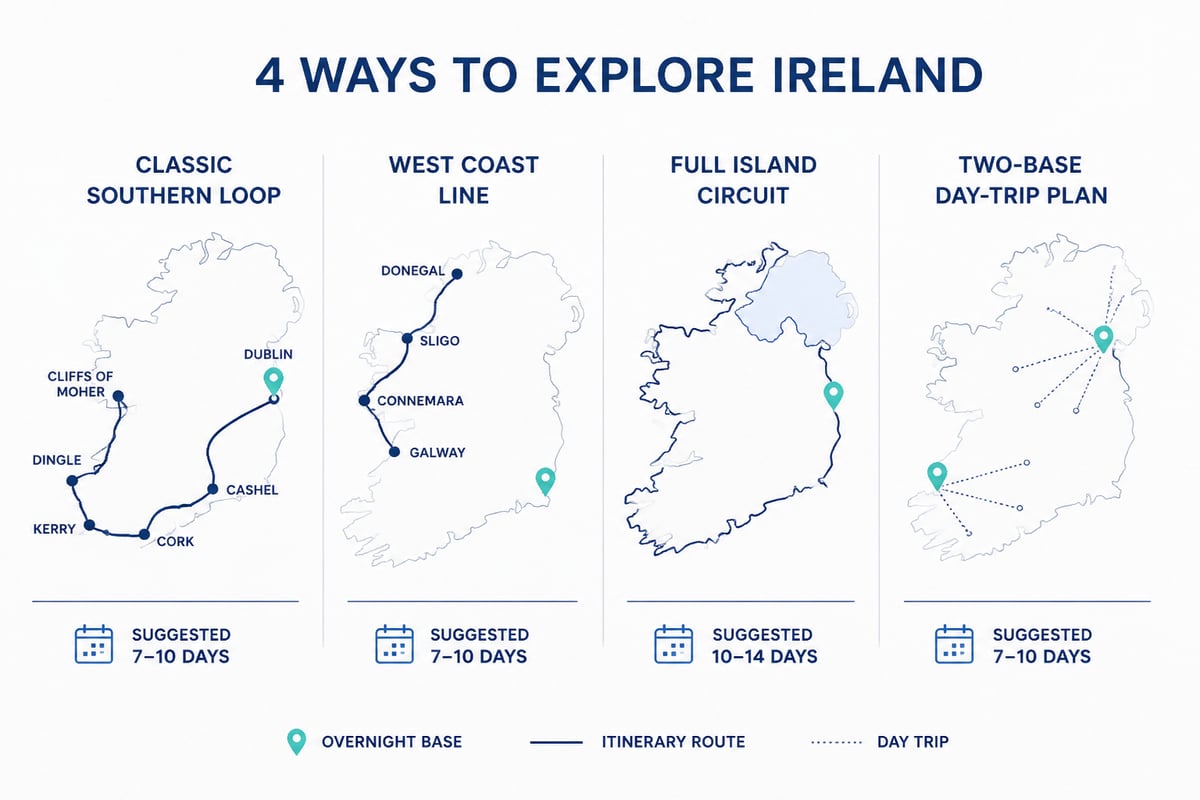
Most independent travelers build one of four shapes:
- The classic southern loop. Dublin, the Rock of Cashel, Cork, Blarney, Kinsale, the Ring of Kerry, the Dingle Peninsula, then north to Limerick and the Cliffs of Moher.
- The west coast line. Galway, Connemara, Westport, Sligo and Donegal, with long scenic days and fewer crowds.
- The island circuit. Dublin south to Kerry, up the west coast, across the north into Northern Ireland, and back down to Dublin.
- The two-base approach. Stay in Dublin and Galway, or Cork and Killarney, and take day trips from each.
If this is your first visit and you have about a week, the southern loop gives the highest return on time. If you have already seen the greatest hits or dislike tourist crowds, the west coast line trades famous stops for emptier roads and big landscapes.
Our team has also written a detailed overview of how to travel through Ireland if you want to compare more route ideas before committing.
When Is the Best Time to Go?
Late spring and early autumn offer the best balance of mild weather, long daylight and manageable crowds, though the right month depends on what you want from the trip.
Here is how the seasons compare:
| Season | Typical advantages | Trade-offs |
|---|---|---|
| Spring (April to May) | Long evenings, green landscapes, fewer visitors | Cool, showery weather; some attractions on reduced hours |
| Summer (June to August) | Longest days, full opening hours, festivals | Highest prices, busiest sights, tight accommodation |
| Autumn (September to October) | Calmer roads, good light, lower demand | Shorter days by late October, more rain |
| Winter (November to March) | Lowest prices, cozy pubs, quiet landscapes | Short days, closures in rural areas, rough weather |
Visitor behavior follows a similar pattern. CSO data for September 2025 shows an average stay of 7.1 nights, shorter than August, which suggests the shoulder season may attract shorter trips. For a deeper month-by-month breakdown, read our guide to the best time to visit Ireland.
Whatever the season, pack for four kinds of weather in one day. A waterproof jacket matters more than an umbrella, which rarely survives Atlantic wind.
How Do You Get Around Without a Tour?
A rental car gives you the most freedom, but trains and buses can carry you between major cities if you prefer not to drive.
Driving. Ireland drives on the left, and many rental cars are manual, so book an automatic early if you need one. Rural roads are narrow, often without shoulders, and speed limits are posted in kilometers per hour on most roads. Build in extra time for single-track lanes where you may need to reverse to a passing point.
Trains and buses. Rail links Dublin with Cork, Galway, Limerick, Belfast and other cities. Buses fill gaps to smaller towns, though schedules thin out in the west and northwest. A public transport plan works well for a city-focused trip but becomes slow if you want peninsulas and coastal drives.
Mixed approach. Many travelers take a train between Dublin and Cork or Galway, then rent a car locally for the scenic region. This avoids driving in city traffic and cuts rental costs.
For a closer look at each option, including how schedules and coverage work, see our overview of transportation in Ireland. If you are leaning toward a drive, our Irish road trip guide covers routes and practical tips in more depth.
Should You Include Northern Ireland?
Include Northern Ireland if you can spare at least two extra days, since its coastline, Belfast and the Giant's Causeway are distinct from anything in the Republic.
Northern Ireland is part of the United Kingdom, which affects currency, phone roaming and some practical details. Prices are quoted in pounds sterling there, and road signs switch from kilometers to miles. There is no passport control at the land border, but your mobile plan may change networks without warning, so check roaming charges before you cross.
Our comparison of the Republic and Northern Ireland explains these differences in detail.
What Does a Realistic 7-Day Plan Look Like?
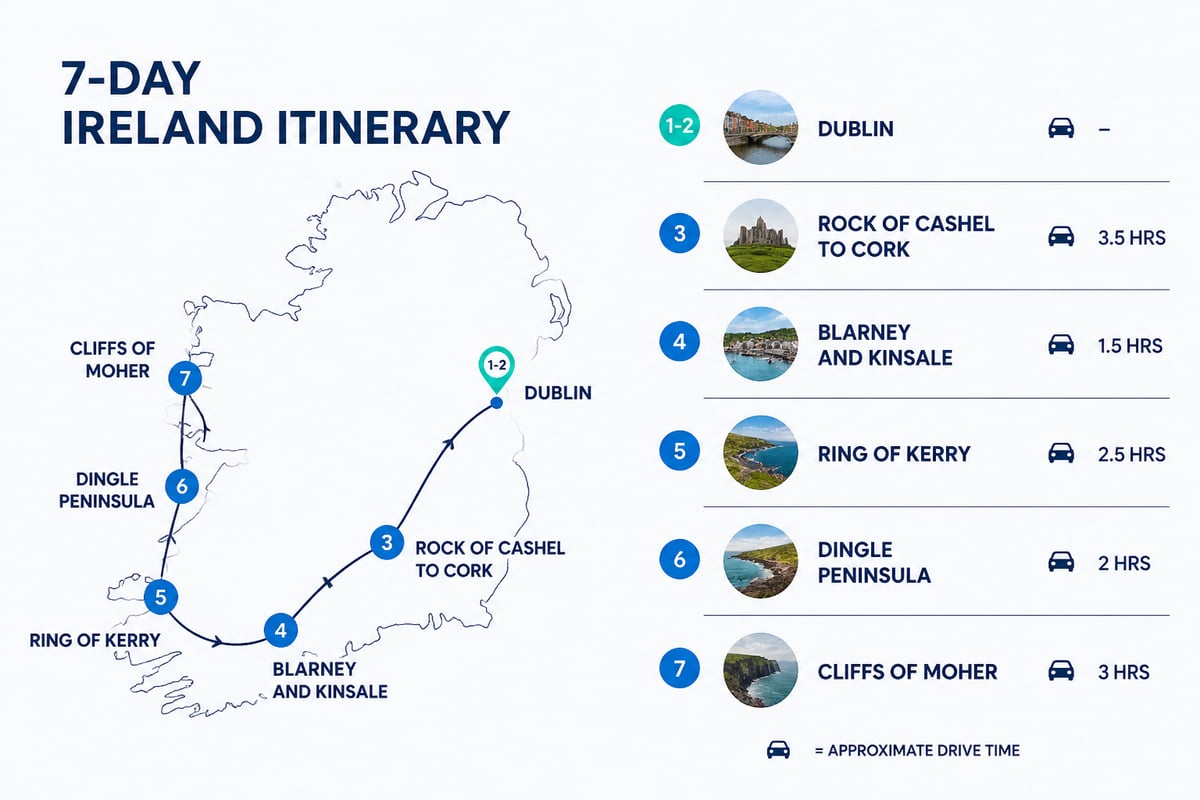
A realistic week runs from Dublin to the south and southwest with no more than one major drive per day.
- Day 1: Dublin. Trinity College, the Book of Kells and an evening walk through the city center. Keep the first day light to recover from the flight.
- Day 2: Dublin. Kilmainham Gaol and the Guinness Storehouse. Book timed entry in advance during busy months.
- Day 3: Rock of Cashel and Cork. Drive south, stopping at the Rock of Cashel before reaching Cork for the night.
- Day 4: Blarney and Kinsale. Spend the morning at Blarney Castle, then take the coast road to Kinsale for lunch and harbor views.
- Day 5: Ring of Kerry. Base yourself in Killarney and drive the loop clockwise or counterclockwise, stopping at viewpoints and small villages.
- Day 6: Dingle Peninsula. A shorter, scenic day with Slea Head Drive and an evening of live music.
- Day 7: Cliffs of Moher and onward. Travel north through Clare toward Shannon or Galway, depending on your departure airport.
Notice what this plan avoids: two long drives back to back. If the weather turns, you can swap any two days without ruining the schedule.
How Do You Budget for the Trip?
Budget by splitting costs into lodging, transport, food and entry fees, and expect spending to rise in summer and in Dublin.
Visitor spending data gives a useful reference point. The CSO estimates that foreign visitors spent €5.5 billion in Ireland in 2025, excluding fares. Per-trip figures vary by month: in September 2025, the average trip expenditure excluding fares was €944, according to the CSO.
To keep costs under control:
- Book accommodation early for July and August, especially in Dingle, Killarney and Galway.
- Choose B&Bs and guesthouses over hotels. They often include a full Irish breakfast that covers lunch.
- Eat your main meal at midday, when pub menus and set lunches cost less.
- Buy attraction tickets online where discounts apply.
- Fill the tank at supermarket stations rather than motorway services.
If cost is your main constraint, our guide to budget trips to Ireland shows where to save without cutting the best experiences.
What Mistakes Should You Avoid?
The most common errors are overpacking the schedule, underestimating drive times and booking lodging too late.
Watch for these:
- Trying to see everything. Fewer stops with more time in each leaves you with better memories than a daily checklist.
- Trusting the map distance. Plan 40 to 50 miles per hour as an average on rural roads, and less in the west.
- Skipping reservations. Popular restaurants, distillery tours and small-town accommodation fill up weeks ahead in summer.
- Ignoring the weather. Keep one flexible day for storms, when ferries and some coastal sights may close.
- Packing for one climate. Layers, waterproof shoes and a warm sweater suit almost any month.
Our list of common mistakes American tourists make in Ireland goes into more detail on etiquette, tipping and driving habits.
How Can a Digital Guide Simplify Your Planning?
A well-researched digital guide replaces dozens of browser tabs with one organized reference you can search on your phone while you travel.
The Awesome Guide to Ireland is available as a PDF, an eBook or a PDF and eBook bundle. Awesome Travel Guides states that more than 200 hours of research go into every guide and that buyers receive free updates for one year. Layouts are designed for screens, with clickable links, so you can jump from a route outline to a specific town without scrolling through endless pages.
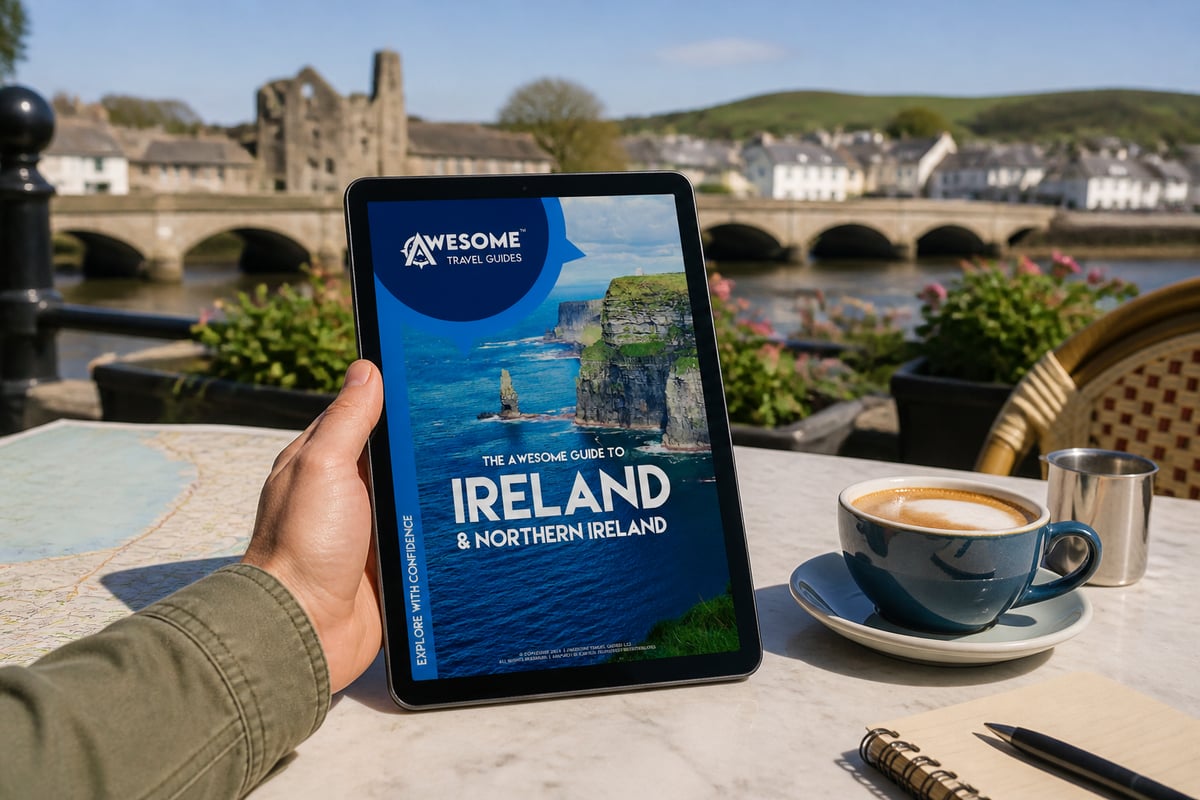
For independent travelers, that structure matters. You can plan the broad outline at home, then use the guide on the road to make small decisions: which pub to try, which detour is worth the extra half hour, which village to stop in for lunch.
If you are deciding between a single-base trip and a longer circuit, our overview of trips to Ireland can help you compare formats.
Why Are People Visiting Ireland, and What Does That Mean for You?
Most overseas visitors come for leisure or to see family, which shapes how busy certain places feel at certain times.
According to the CSO, 40% of overnight foreign visitors in 2025 said their main purpose was holiday, leisure or recreation, while 35% came to visit friends or relatives. In June 2025, the CSO reported that 47% of overseas visitors were there for holiday or leisure and 30% were visiting friends or relatives. Leisure travel is strong in early summer, which helps explain why the most photographed sights feel busy in June.
The practical takeaway is simple: if you want space, aim for shoulder months, visit headline attractions early in the morning, and save quieter villages for the afternoon. Our feature on charming Irish villages is a good source of lower-profile stops to add to a route.
Where Should You Stay, and How Do You Choose?
Choose lodging by location first and price second, since a base that cuts an hour of driving is worth a modest premium.
A few tested principles apply:
- Stay two nights where you can. One-night stops consume mornings packing and evenings checking in.
- Pick walkable towns. Kinsale, Dingle, Kenmare and Westport let you leave the car parked and walk to dinner.
- Book flexible rates where possible. Weather and plans change, and free cancellation protects you.
- Check parking. City hotels often charge for it, while rural B&Bs usually provide it.
- Consider local advice. Hosts at small guesthouses often know which roads are closed and which pubs have music that night.
Home and property services are part of the Irish economy too. If you are curious about how Dublin's building trades are shaping the city, companies such as Phoenix Maco Ltd work on renovations and extensions across the capital, a reminder that much of the architecture you will admire is also in daily use.
What Final Checks Should You Make Before You Go?
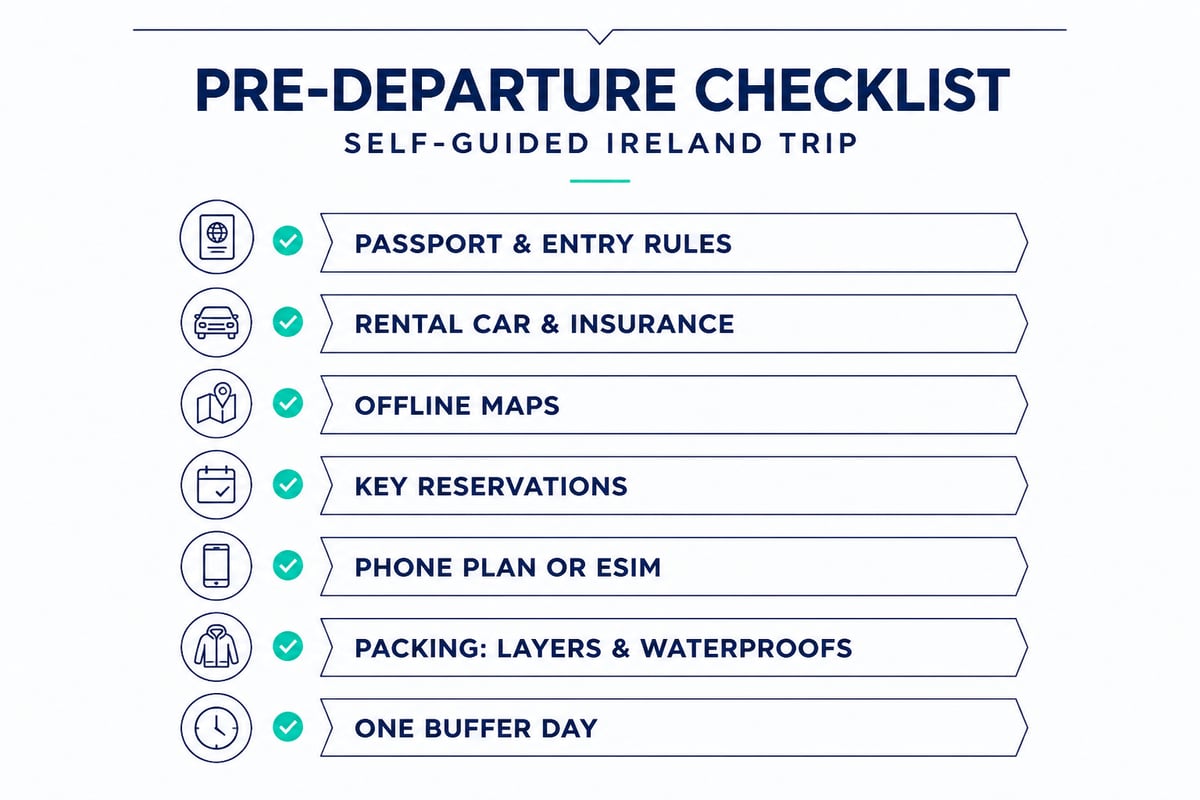
Confirm your documents, bookings, phone plan and driving permissions at least two weeks before departure.
Use this short checklist:
- Check passport validity and any entry authorization required for your nationality.
- Confirm your rental car, including transmission type and insurance coverage.
- Download offline maps for the regions you will cross.
- Reserve the three or four experiences you cannot miss, such as a distillery tour or a popular restaurant.
- Arrange a phone plan or eSIM that works on both sides of the border.
- Pack layers, waterproof shoes, a power adapter and a small daypack.
- Leave one buffer day in your itinerary.
Start today by choosing one route shape from this guide and writing down the three places you refuse to miss, then build the rest of the days around them. When you are ready for a single, organized reference to carry on the road, The Awesome Guide to Ireland pulls researched routes, local tips and hidden gems into one searchable file. If you want to browse the full range of independent, regularly updated digital guides, you can find them through Awesome Travel Guides, where you can shop guides built for confident, self-planned travel.